
Introduction
In the age of automated tools and machine learning, it’s tempting for businesses and creators to rely on AI-driven cutout tools for every image-editing task. These tools are fast, cheap, and accessible — and for simple, low-stakes projects,
They often do an adequate job. But when the image matters — for product catalogs, high-end advertising, e-commerce listings, or brand-sensitive marketing — professional clipping path services still win. This post explains why professional clipping path remains the better choice for precision, consistency, and brand integrity, and helps you decide when the extra investment matters.
What is a clipping path, and how does it differ from AI cutouts?
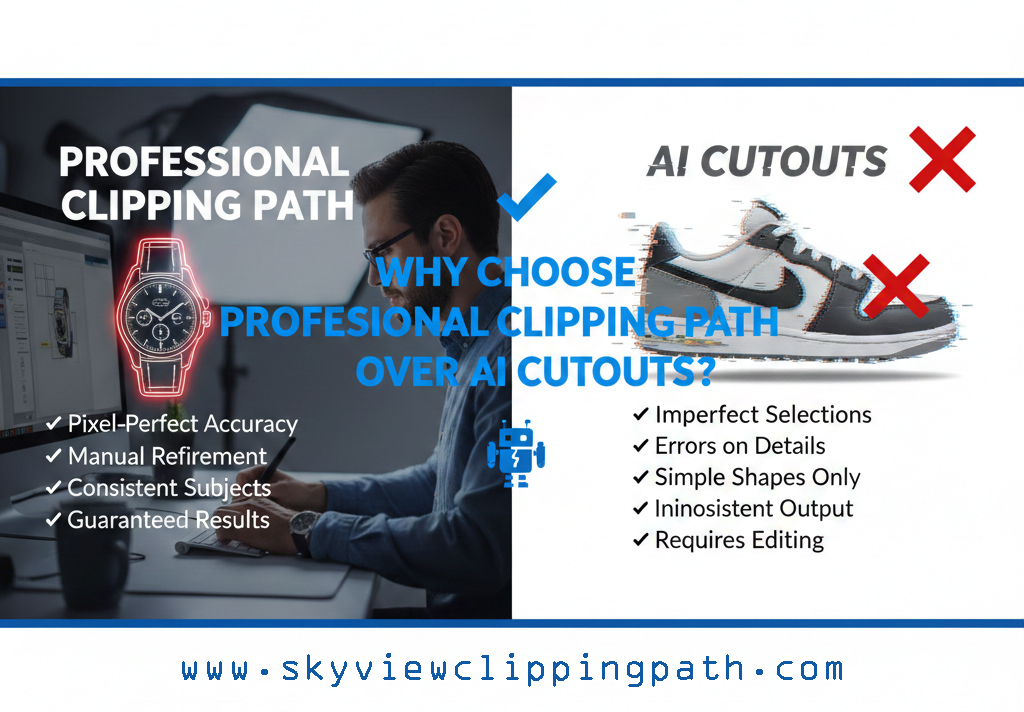
A clipping path is a hand-created vector outline around a subject (usually made in Adobe Photoshop or Illustrator) that separates the subject from its background. A trained designer draws the path carefully, ensuring smooth, accurate edges, preserving hair, fur, transparent sections, and fine curves.
AI cutouts use algorithms (often deep learning models) to detect and remove backgrounds automatically. They are fast and require little human input. However, they rely entirely on pattern recognition and probability, which can produce errors in complex scenes, fine details, or brand-sensitive compositions.
Precision: the human advantage
Professional clipping path artists work with control and intention. They can:
- Follow complex contours (lace, hair, jewelry prongs) with pixel-level accuracy.
- Preserve fine details like wisps of hair, translucent fabrics, or glossy reflections.
- Adjust anchor points and Bezier curves to avoid jagged edges or lost detail.
AI tools often fail with semi-transparent objects, similar foreground/background colors, or fine textures. The result: cut halos, missing details, or distorted edges that look unprofessional.
Consistency across large batches
E-commerce catalogs and brand galleries require consistent results across hundreds or thousands of images. Professional teams establish style guides (edge handling, shadow style, background color, color correction standards) and apply them consistently. Humans can be trained to replicate a look exactly; they can test and iterate when a batch contains tricky items.
AI is consistent in the sense of applying the same algorithmic rules, but that doesn’t always equal visually consistent. Small lighting differences or fabric textures can cause AI to produce inconsistent masks, requiring manual correction anyway.
Brand safety and custom handling
Brands often have specific visual requirements: exact product orientation, preserved reflective highlights, controlled shadows, and specific margins for drop-shadows. Professional clipping path services can follow brand rulebooks and handle edge cases (transparent packaging, jewelry stones, hairpieces) with custom techniques — something AI tools are not designed to do without explicit manual oversight.
Additionally, a human editor can catch and correct brand-sensitive problems (watermarks, mis-placed logos, or unflattering product positions) before final delivery.
Complex objects and tricky materials
Materials like hair, fur, glass, fine lace, or translucent plastics are notoriously difficult for automated tools. A clipping path specialist combines vector paths with layer masks, manual feathering, and multiple passes to maintain detail. They can also integrate manual retouching (dust removal, specular highlight control) that keeps the final image both realistic and polished.
Color accuracy and post-processing decisions
AI cutout services can separate subject from background, but they rarely make the nuanced post-processing decisions a pro would: color cast correction, selective sharpening, edge blending to match new backgrounds, or subtle retouching that preserves texture while removing distractions. Professionals understand color profiles and can deliver images prepared for your final medium (web, print, billboard).
Problem-solving and quality control
Human editors don’t just run tools; they inspect outputs and make judgment calls. When something looks off, an editor can troubleshoot — change the path approach, use hair masking, or manually reconstruct areas. Professional workflows include QC steps to ensure images meet the client’s acceptance criteria. AI services rarely offer this level of iterative quality control unless you pay for manual review.
Cost vs value: when to invest
AI cutouts are excellent for low-cost, high-volume needs: quick mockups, user-generated content, or internal-use images. Professional clipping path is the right investment when:
- The images represent your brand publicly (product pages, ads, catalogs).
- Small visual errors would reduce buyer trust or increase returns.
- You need consistent, repeatable results across large batches.
- The objects are complex (hair, transparent or reflective surfaces).
- You require color-accurate, print-ready files.
Think of AI as “fast and cheap” and professional clipping path as “precision and brand security.” Both have a place — the trick is matching the tool to the need.
Turnaround and scalability
Many professional services offer rapid turnaround and scalable teams that can handle bulk jobs while maintaining quality. They can also provide layered PSDs, multiple file formats, and different crops — all tailored to platform specs. If you rely solely on an AI tool, you may save time upfront but spend more time fixing inconsistent outputs later.
Hybrid workflows: best of both worlds
A smart approach is hybrid: use AI cutouts for the first pass, then have human editors check and refine the most important or problematic images. This can save time while preserving quality where it matters. Professional clipping path services are increasingly integrating AI tools into their workflows to speed up routine steps while keeping human oversight for critical fixes.
FAQs
- Q: Are AI cutouts ever as good as a professional clipping path?
- A: For very simple subjects against plain backgrounds, modern AI tools can produce results that appear comparable. However, for fine details, transparent materials, or brand-sensitive images, professionals typically produce superior and more reliable outcomes.
- Q: How much more does a professional clipping path cost?
- A: Prices vary by region, complexity, and volume. Simple clipping for straightforward products is cheaper; detailed hair masking, multi-path work, and retouching increase the cost. Consider the cost relative to the value of a high-converting product image — small increases in conversion rate often justify the expense.
- Q: Can I use AI for initial sorting and pros for the rest?
- A: Yes. A hybrid workflow is efficient. Use AI to pre-segment easy items and route complex or high-value images to professional editors for final quality control.
- Q: How long does professional clipping path take?
- A: Turnaround depends on volume and complexity. Many professional teams offer same-day or 24–48 hour turnaround for moderate batches, and scalable teams can handle larger workloads quickly while maintaining consistent quality.
- Q: Do professionals deliver layered files?
- A: Most professional clipping path services deliver layered PSDs, transparent PNGs, and multiple output formats per client’s needs, including print-ready TIFFs or specific web dimensions.
- Q: Can professionals mimic the look of AI-generated images?
- A: Yes — professionals can produce look similar to automated outputs, but with the benefit of manual precision and quality control, ensuring a cleaner, brand-consistent result.
Conclusion
AI cutouts have transformed how quickly anyone can remove backgrounds and produce usable images. But professional clipping path services remain the gold standard wherever precision, consistency, and brand integrity matter. Whether you choose a full professional workflow, an AI-first hybrid, or pure automation depends on your budget, the complexity of your images, and how critical those images are to your business. For product photography, luxury items, and marketing materials that represent your brand to the world, a professional clipping path is an investment that pays off in trust, conversions, and visual quality.